Gage Blocks: Frequenty-asked questions
1) IS AUTHORIZATION NEEDED TO SEND IN GAGES FOR CALIBRATION?
No. But we do ask that you either include a copy of your purchase order with the shipment or reference your purchase order number on the packing list. This will speed up processing of your order.
2) HOW OFTEN SHOULD GAGE BLOCKS BE CALIBRATED?
Industry consensus is that gage blocks be calibrated every 1 to 3 years. Calibration intervals may be shortened or lengthened as needed. The frequency of calibration is determined by the user with consideration given to usage, care, and desired accuracy.
3) WHEN IS A USED BLOCK RECOMMENDED FOR REPLACEMENT?
You, the user of the blocks can specify your own replacement tolerances according to your needs. These requirements should be stated on our purchase order.
If you specify a grade on your Purchase Order:
a. For blocks calibrated to the old GGG-G-15C specification, we will add our uncertainty of measurement, both plus and minus, to the tolerance before marking a block out of tolerance. This is in accordance with procedures written in the GGG specification for used gage blocks.
b. For blocks calibrated to the new B89.1.9 standard, we will mark out of tolerance any block that is measured beyond the published tolerance UNLESS instructed by you, the user, to add our uncertainty of measurement, both plus and minus, to the tolerance.
(The B89.1.9 standard does not specify tolerances for used gage blocks. ) NOTE: If calibration lo a grade is required, it is our recommendation to only replace blocks that exceed published tolerances plus the uncertainty of measurement.
You may specify your own replacement tolerances on your purchase order. The old 10 to 1 Tool Maker's rule is a very useful guide. For example, if you are using the gage blocks to calibrate micrometers with a resolution of .0001 inches, then having your gage blocks calibrated to a tolerance tighter than .000010 inches (10 microinches) is probably not necessary.
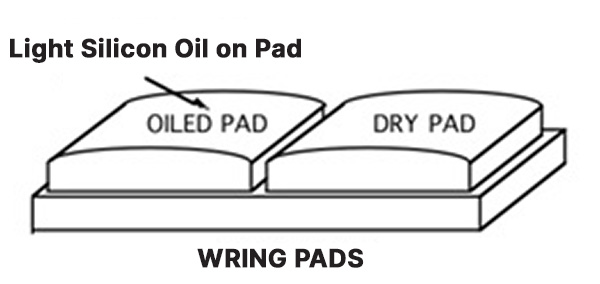
If you use your gage blocks in combinations by wringing blocks together, then we recommend replacing any block that has lost its wringability.
4) MY OLD SET WAS MANUFACTURED TO THE OLD TOLERANCES CONTAINED IN GGG-G-15C. ARE REPLACEMENT BLOCKS AVAILABLE?
Yes. But, this may require us to do a little searching through our inventory for blocks to meet the lighter GGG tolerances. Thus, there is a 10% surcharge for gage blocks ordered to the GGG-G-15C specification.
5) DOES WEBBER CHECK BLOCKS FOR WRINGABILITY DURING CALIBRATION?
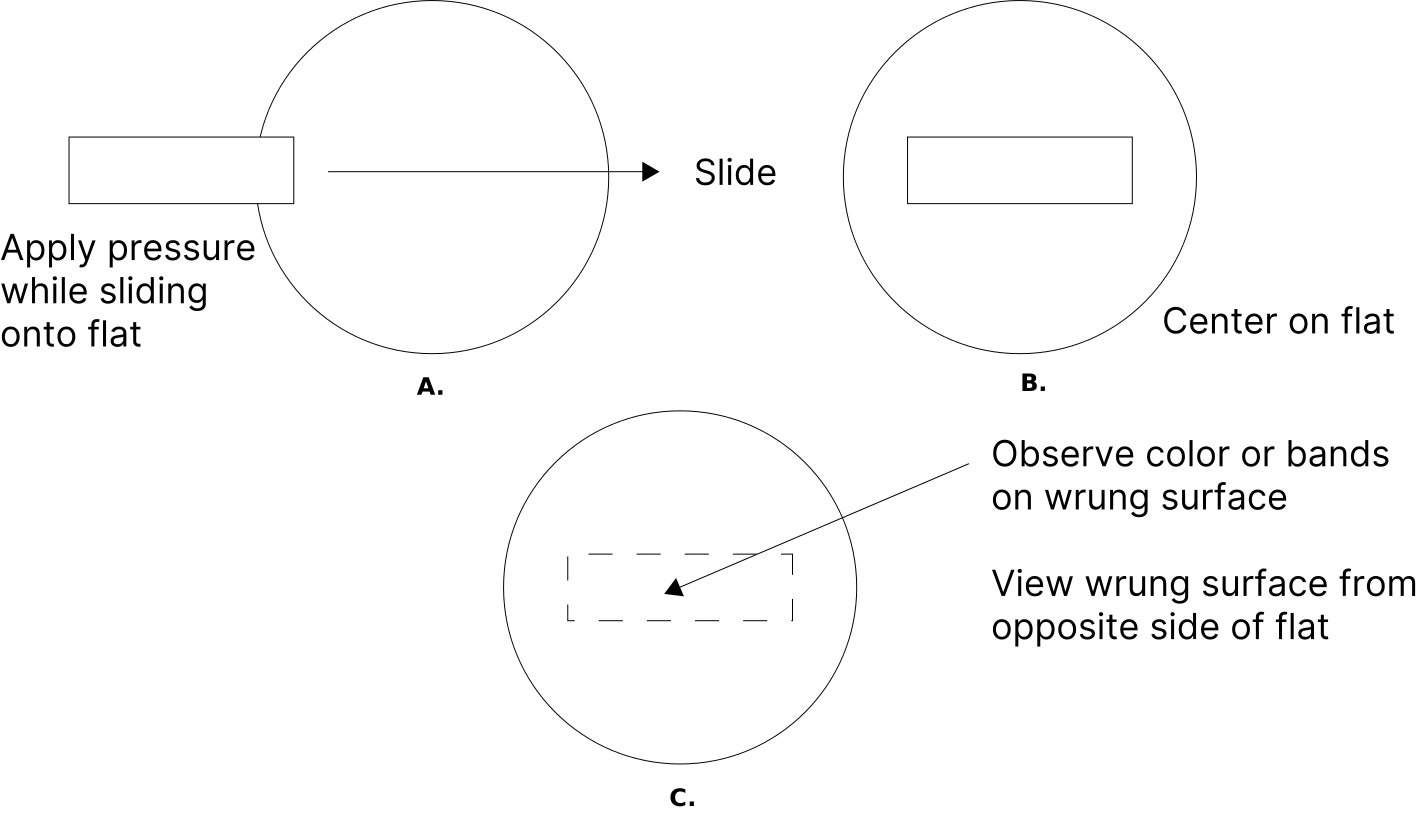
Wringability is NOT checked for every block unless requested. There is an additional charge for this service as both sides of the blocks are wrung either to a test block or to an optical flat. However, even if the additional test is not performed, if a block is obviously damaged, it will be noted on the Certificate of Calibration.
Wringability may be checked by you, the user of the blocks. This check does not require an accredited laboratory. Upon request, we will provide you with procedures to check for wringability.
6) DOES A WEBBER CALIBRATION INCLUDE A CHECK FOR PARALLELISM (VARIATION IN LENGTH) AND FLATNESS?
All Webber calibrations check for parallelism (Variation in Length). Flatness is NOT usually checked except as an additional test using an optical flat and/or a flatness interferometer al extra cost. As a rule, we do not usually recommend a separate flatness calibration. It is our experience that if a block is within its parallelism tolerance, it is also within its flatness tolerance.
7) CAN A LOWER GRADE SET BE CALIBRATED TO A MORE ACCURATE GRADE?
No. The grade of the blocks cannot be upgraded by calibration. The grade of a block is dependent on its geometry (flatness and parallelism} that cannot be changed by inspection.
8) CAN OUT OF TOLERANCE GAGE BLOCKS BE REWORKED OR RECONDITIONED?
It is usually not economical to recondition used gage blocks because the material cost in a gage block is a small percentage of its list price. In production runs, the volume of gages produced keeps labor costs per piece to a minimum. The labor required to make a single good block from a used bad one would far exceed the price of a new block. AN EXCEPTION may be for longer gage blocks, 5 inches (125mm) and above in length, provided they are not undersized or severely tapered.