Instructions and Suggestions for the Use and Care of PRECISION GAGE BLOCKS
Gage blocks are measuring tools of the highest order. They must be used with great care, and if properly handled, will give long. useful service. However, gage blocks are primary standards of length, and when used as working gages they must be handled in a manner that will conserve the original accuracy and fine finish of the gage surfaces. When these blocks were delivered to you , the box was sealed with tape and enclosed in a vacuum sealed bag. This is your assurance that these gages have not been tampered with since their inspection and packing at our plant.

CLEAN GAGE BLOCKS BEFORE AND AFTER EACH USE
- When using the gages, the blocks should be wiped off with a soft cloth dampened lightly with mineral spirits to remove any corrosion resisting oil or other oils, grease, or dirt that may be on the gage. Do not use chlorinated solvents to remove grease from the blocks or to clean the slots of the case.
- Whenever the gages are used around grinding equipment or in any place where there is dirt, always keep the lid of the case closed.
- After using steel gages, wipe them with a chamois dampened with a rust preventative oil such as Starrett M-1, holding the block in such a manner that your fingers never touch the block. (Finger oils may contain acids which may corrode steel blocks.) Place the block back into its case using the chamois to shield the gage from your fingers and hand.
Croblox® and ceramic gage blocks should be wiped off with a clean chamois before placing back in the case.
WRINGING GAGE BLOCKS
- When wringing gages together to build up a desired combination, first wipe the gage with a soft cloth which has been prepared with a few drops of light machinery oil. Then, using a second soft cloth, wipe off any excess oil. Then, carefully slide the blocks together while exerting pressure to force out any air that may be between the blocks. The blocks should then take hold and adhere to each other very tightly.
- DO NOT wring blocks together above an open set. If they should slip and fall into the open set, they could damage themselves and several blocks in the set.
- Never leave steel gages "wrung" together for a considerable amount of time as there is a possibility of moisture being trapped between the surfaces which could cause the surfaces to corrode.
USE OF WEAR BLOCKS
- Wear blocks are "throwaway" blocks whose purpose is to prevent wear on other gage blocks.

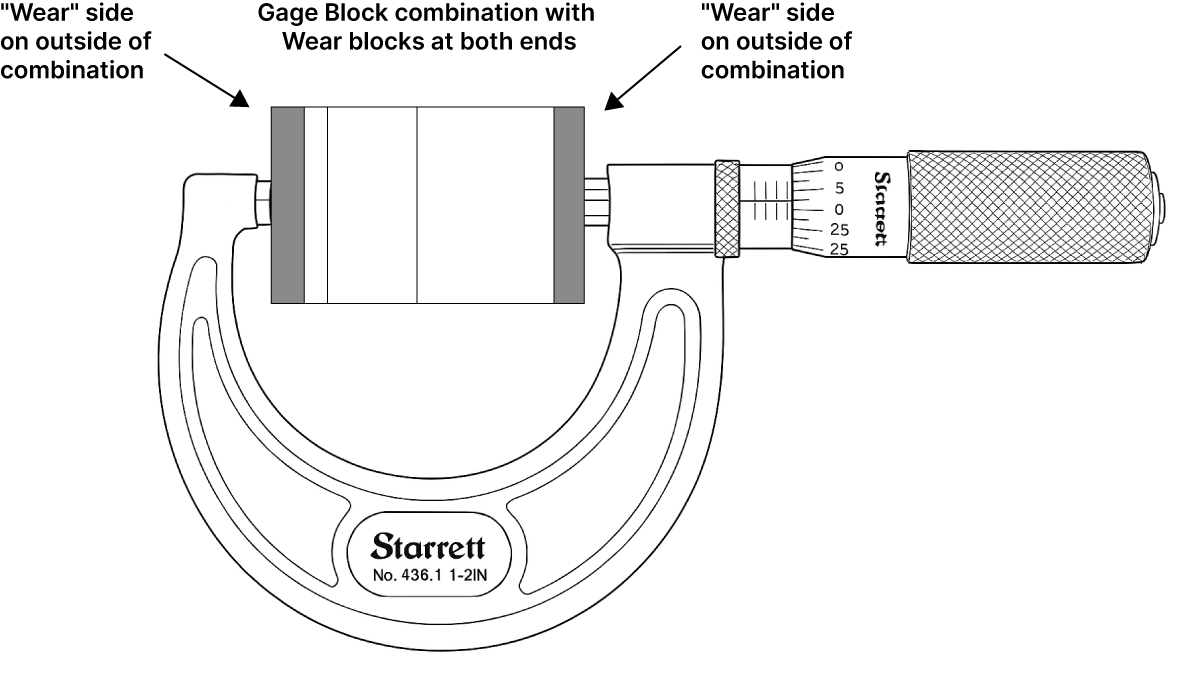
- Wear blocks are used at both ends of combinations and are meant to take the brunt of the contact with other measuring instruments such as micrometers. The desired length of the combination must include the wear blocks. One side of the wear block is marked "wear". This side should always be on the outside of the combination. Inspect the nonwear side of the block before using it in a combination. The non-wear side to be wrung to the other gages should not itself scratch any of the blocks it is supposed to protect. When wear blocks become worn or scratched, they may be discarded and replaced.
- "Wear" blocks are made from croblox® material to give longer life and make them more resistant to scratches.
STONING GAGE BLOCKS
- After gage blocks have been used, you may find a block which will not wring together with another block. The trouble is the block has become nicked or scratched during use. If you examine the block carefully with a magnifying glass, you may discover a small burr, usually at the edge of the block. This burr must be carefully removed to restore the block to usefulness. This may be done by stoning.
- Blocks may be stoned with Webber gage block stones to remove light nicks and scratches. Light stoning will not alter the size of the gage block.
- Blocks that are severely damaged will probably not be repaired by stoning. They should be replaced.
TEMPERATURE AND GAGE BLOCKS
- Gage blocks and most other materials and objects such as micrometers and calipers expand or become larger as the temperature increases. This change is given by the formula:
CHANGE =length of block)( (Temperature of block -68) ) x Expansion Coefficient
- For a 4-inch steel block at 76°F with an expansion coefficient of .0000064, the block grows by 4 x (76-68) x .0000064 or .000205 inches.
- When building a combination of gage blocks the heat absorbed from your hands will cause the gage blocks to expand. The gage blocks must be allowed to acclimate to the same temperature as the measuring gage and work piece. (Placing them on a steel or aluminum soaking plate will reduce the acclimation time. Granite plates are not recommended as granite is an insulator and does not conduct heat very well.)
- Parts made from nonferrous materials such as aluminum or brass will have different expansion coefficients than steel. If accurate measurements are required, then careful calculations must be made for the different expansions of the part and measuring gages if they are not being used at 68°F. Consult an engineering or machinist handbook for tables of expansion coefficients for various alloys. Webber lists the coefficients of our gage blocks on the back side of our Calibration Certificates.
- In practical use, if the gage blocks and the work piece and micrometer or caliper are all made from steel, their expansions will be similar.